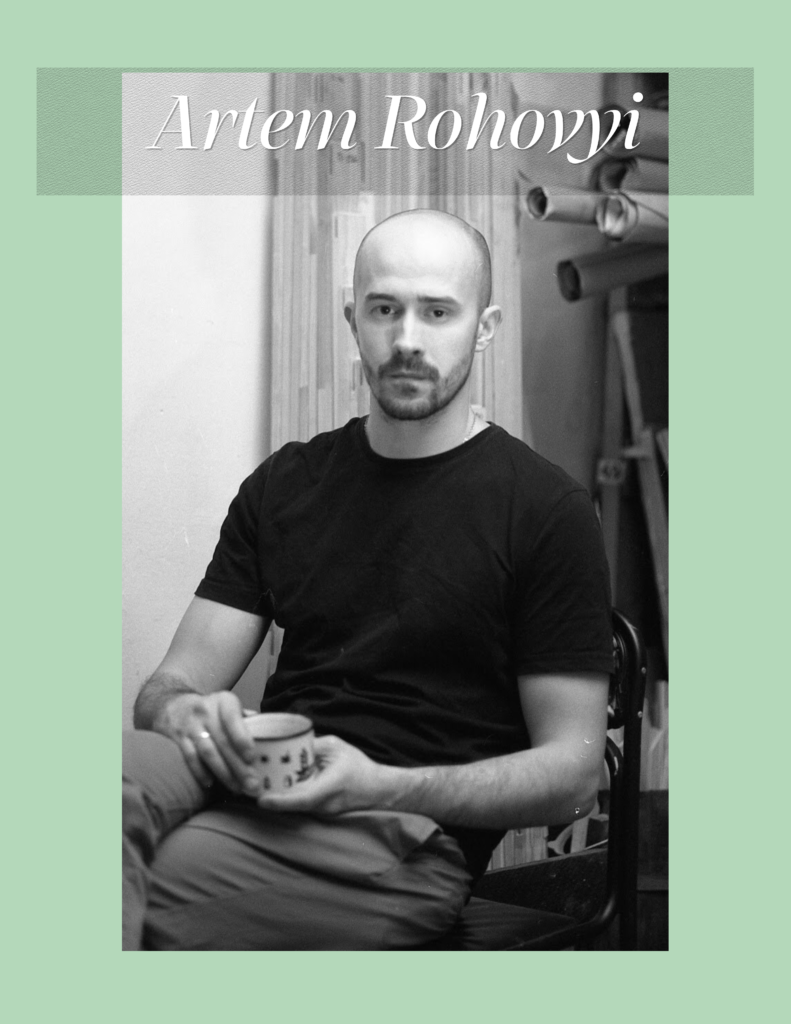
An exclusive interview with Artem Rohovyi

Figurativism in Rohovyi’s Canvas
Rohovyi’s figurativism is an enigmatic amalgamation of Romantic sublimity and Classical idealism, a contemplative delineation of the perfected version of human embodiment set against the wild, sinewy arbor of nature. They offer a compelling elucidation of the temporal interlude and pastoral elements in corporal form. The feminine figure in its innocuous and overt expression is the primary subject of his figurative expedition. Idyllic settings and graceful anatomical renditions of classical physiques saturated in dramatic golden chiaroscuro establish the quiet, introspective tone of his narrative oeuvre. They insinuate an intrinsic influence of antiquity, reminiscent of mythological personas.
A controlled palette of warm analogous color schemes and Eastern-inspired artistic aesthetics often appears as a stylistic infusion in his classical figurative realism. However, his signature pieces integrate a meticulous blend of layering in oil and gold leaf gilding, a stylistic fusion of the Art Nouveau and Symbolism movements, redolent of Austrian artist Gustav Klimt’s “Golden Phase.” The gnarled, twisted trunk of aged trees with willowy branches is as integral to his dramatic composition as his undraped maidens. Speaking of drapery, the fabrics in Rohovyi’s creative body epitomize the graceful and vibrant elegance of traditional Ukrainian scarves featuring distinct floral patterns.
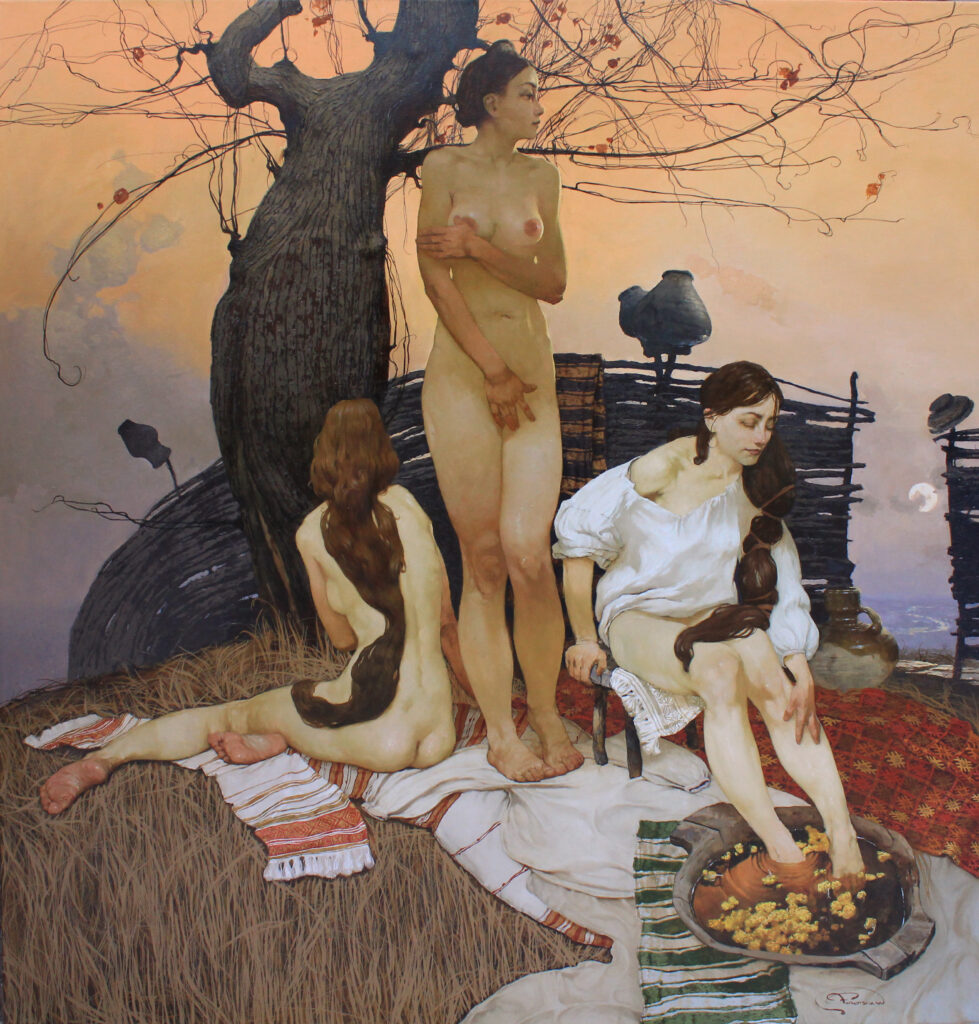
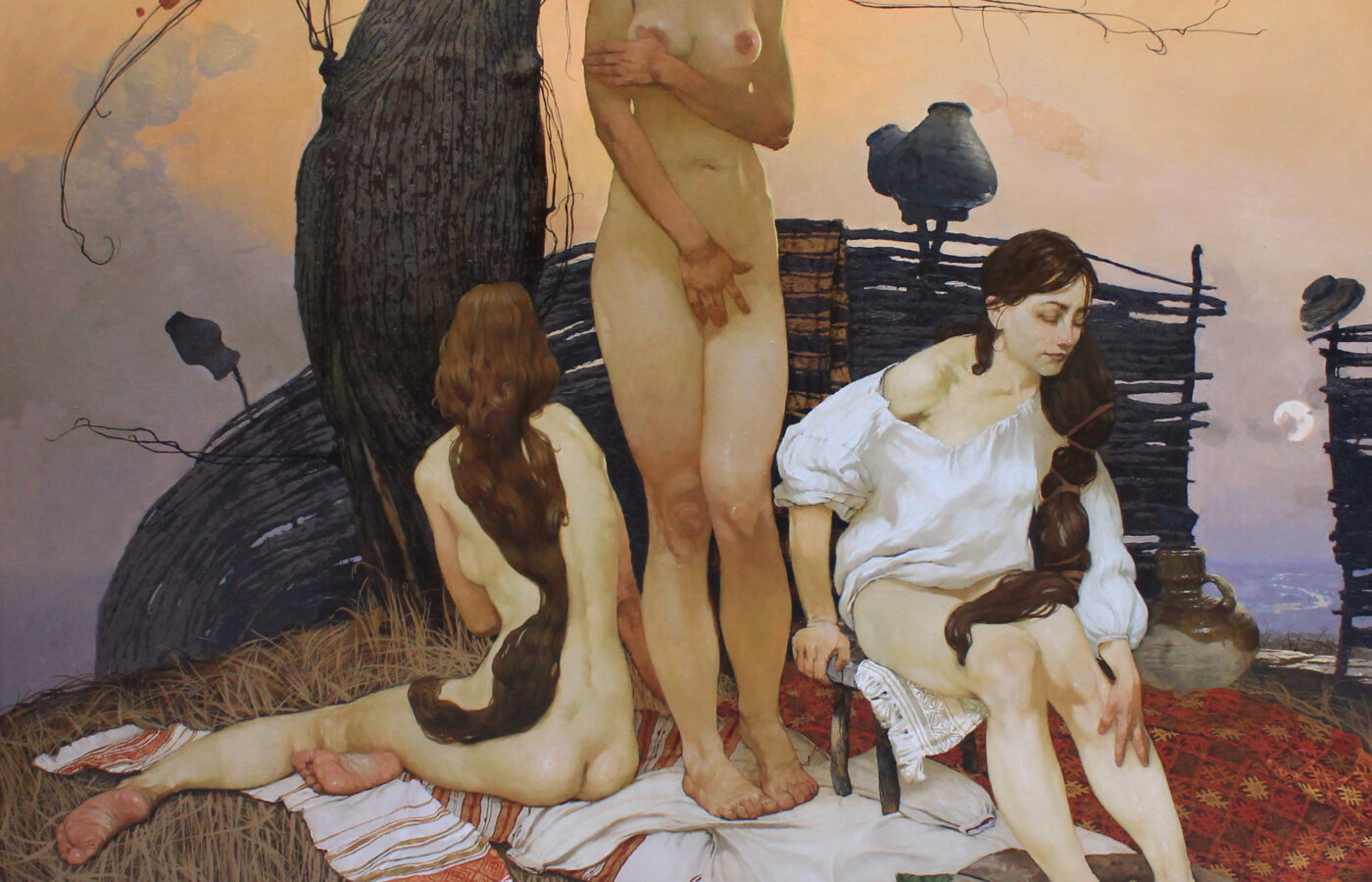
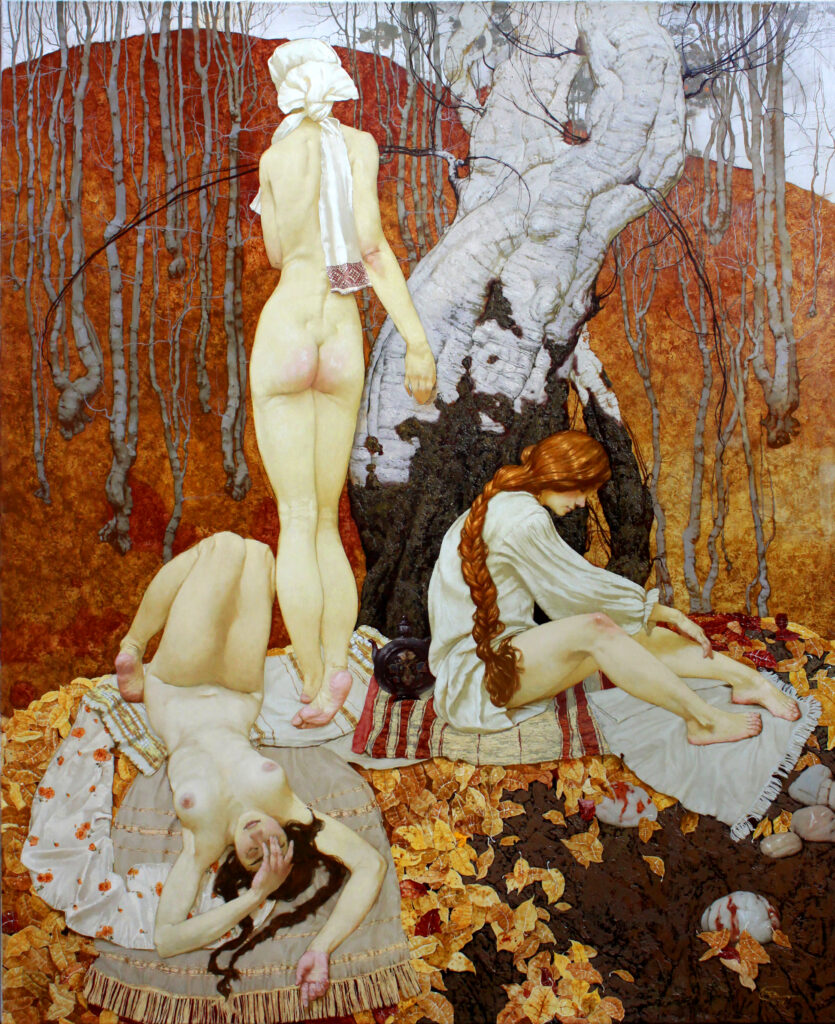
His three prominent artworks, “Indian Summer,” “Red Sun,” and “The Song of Beeches,” transfix three female figures in various stages of dressing. They emulate the essence of the three Graces, minor goddesses of Greek mythology—elegance, joy, and bloom. In “Indian Summer,” the nude woman in the central position tries without avail to cover her exposed chest and lower part, a vision bearing an uncanny resemblance to a life-size sculpture of Aphrodite caught unaware emerging from a bath curved by Greek sculptor Praxitales. The nude woman, on her right, sits with her exposed back to the viewers, and the woman on her left, partially draped, sits on a stool soaking her feet in a wide basin. “The Song of Beeches” is a metaphorical allusion to the autumnal beech forest. It depicts three female figures, either entirely or partially nude, in a pastoral woodland, blanketed by a thick covering of autumnal leaves. The disrobed woman, with only a headscarf wrapped around her head, stands in the center flanked by two other women. The one to her right lies asleep on the forest floor with her bosom exposed to the viewers; her hands rest against her head, covering her countenance. The other woman to her left, partially clothed, sits vertically on the forest floor with her long braided hair cascading down her side profile. “Red Sun” personifies the transitional phase of a woman from girlhood to maturity. Similar to the previous artworks discussed, this composition also portrays a nude female figure standing in the center, facing the setting sun away from the viewers. On either side of her sit two young females in different hairdos; the one on her right has left her hair untied, but the female to her left has tied her hair in an updo, decorated with a crown of flowers. They sit on their knees surrounded by a field of poppy pods while patiently braiding the long hair of the woman in the center.
Plein air landscapes and Chinese expeditions in Rohovyi’s vision
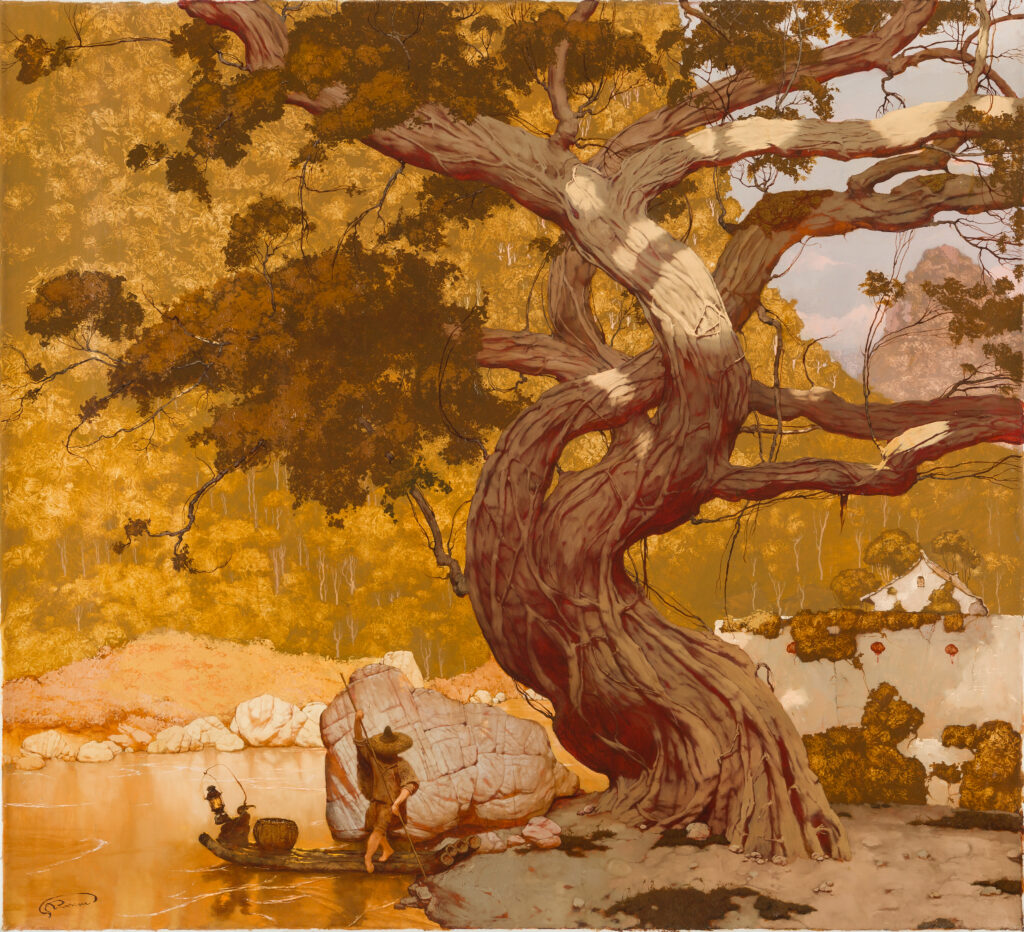
Rohovi’s plein air landscapes, especially influenced by his Chinese expedition, conceived a series of archaic art pieces in stunning oriental exuberances, exploring an invigorating advent that delves into unorthodox blends of complementary techniques from post-impressionism to Chinese shanshui. Earthly palette, architectural elements, muted tones, and diffused ambient glow distinguish his Chinese Painting Series—A Journey in Brushstrokes. “Window to Lijiang,” “Eastern City,” “Warm Huangyao,” and “City on the Silk Road” are some of the most illustrious artworks portrayed in this series. “Eastern City” inaugurates a bird’s-eye perspective of a legacy of Chinese Jiangnan-style buildings in the historical town of Lijiang. The expansive architectural mass is compacted and visualized with loose impressionistic strokes of cool grey and pale blue tones on its triangular tiled roofs, while the large, burly, weathered knob of a tree with its knotted vertical ridges stands as a testament to the heritage below. His “Warm Huangyao” encapsulates the quintessential beauty of the ancient town of Huangyao in a neoclassical, monochromatic golden-amber glow. The gigantic, twisted, zagged, entomorphous form of a banyan tree, nestled along the bank of a small river, commands the center of the art body. The lonely fisherman standing at the edge of the riverbank with a three-log raft boat about to drift off appears to be dwarfed beside the colossal tree. Graphic outlining and atmospheric texturing add warmth and vibrancy to the composition.
The Golden Vision in Rohovyi’s Artscape
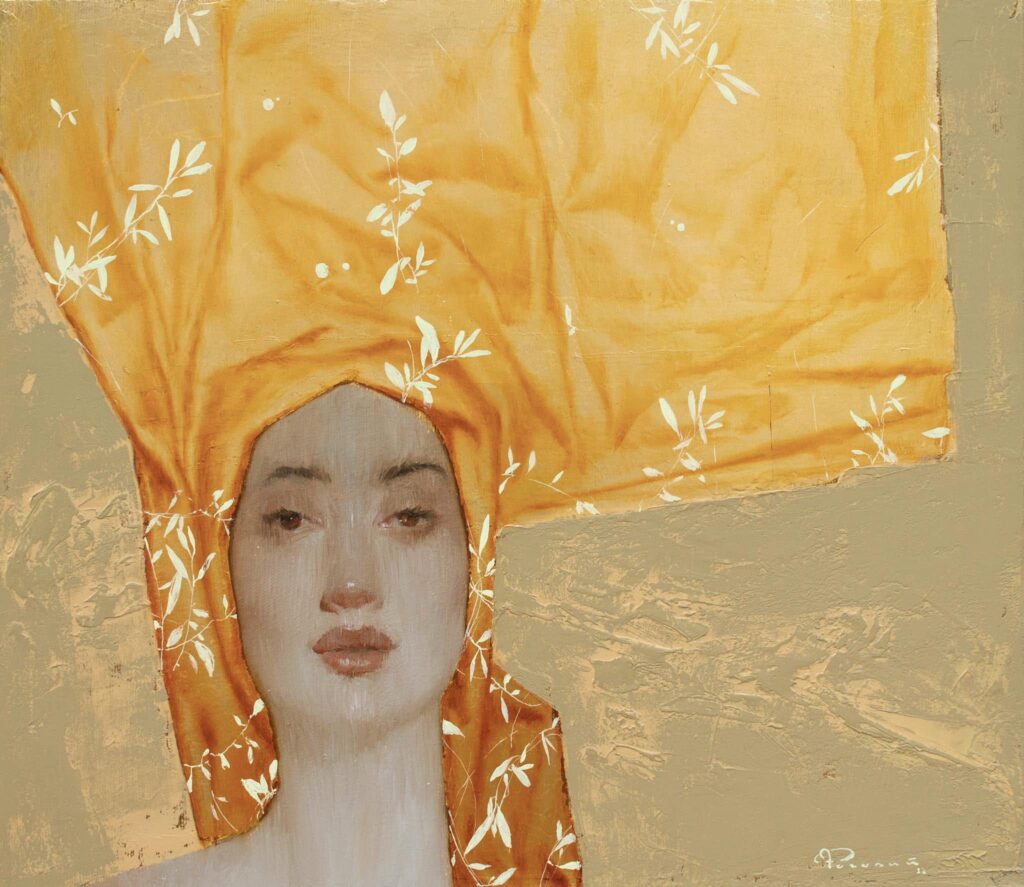
His later figurative artworks lean more toward abstraction and incorporate many patterns and textures, especially in the composition of hair, background, and fabrics. The whiplash pattern of the Vienna session emerged as a significant device in his artmaking, while gold leaf gilding created an embossed effect on the twisted rhythm of hair and in the floral design of the fabric. An intricate, stylized background, mimicking straw, grasses, leaves, woven reeds, etc., also appeared as a grounding feature of his artworks. The gold interwoven in the composition reflected light, creating visual depth and contrast. His artworks—”Chamomile”, “Prairie Mosaic”, and “Sleepyflower art”—are exemplary of this golden style. “Chamomile” paints a sleeping maiden on a bed of dried autumnal leaves blanketed by a fabric of deep brown and grey. Her swooping ringlet of gold-embossed brown hair, decorated in chamomile flowers, fanned around her face, dominating an integral part of the canvas. “Praire Mosaic” illustrates the vision of two maidens blanketed by a beautifully textured fabric of vibrant red, orange, and golden brown patchwork, sleeping on a floor of straw with thick, interlocking laces of their hair fanning out around their faces. The entirety of the composition radiates soft, luminous light; the sharp contrast between the fabric and the complicated mosaic background illuminates as well as separates the subjects of interest from each other.
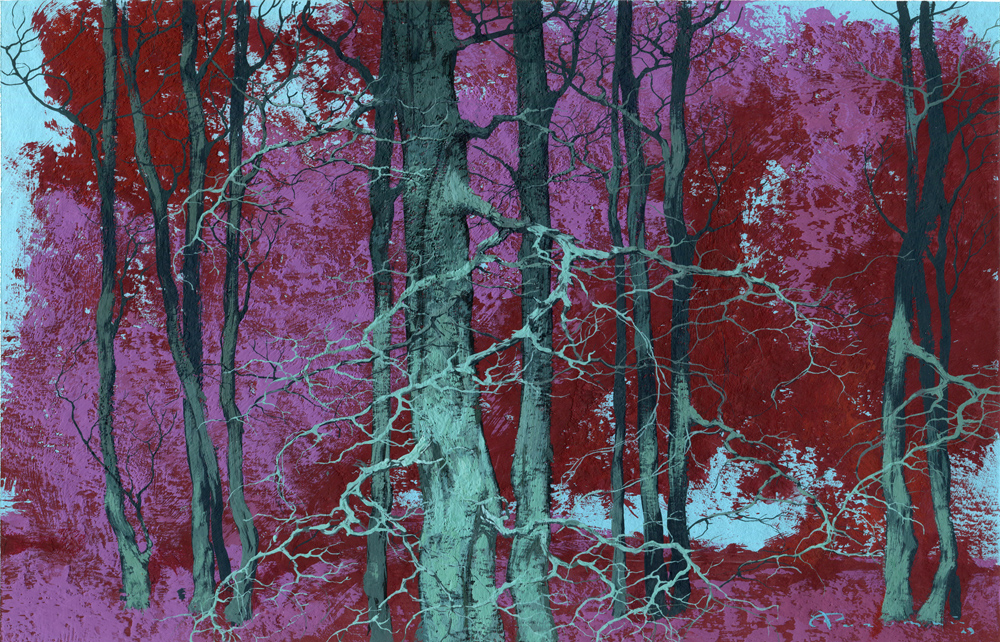
His archetypal impressions discovered a newfound expression in luminescent landscapes with post-impressionist collisionism and an inverted color palette. Sprawling foliage, rugged terrain of twisted trunks, and vibrant incandescence possessed the center stage of this innovative venture. The conjured vision emerged as a composite inoculation of space, form, colors, and rhythm. His treescapes are a rhapsody of intense radiance and radioactive semblance. The capricious prance of windswept, craggy, skeletal branches layered against surrealistic hues set the tone of this expressive paysage. His breathtaking art piece titled “Sketch 77,” rendered in a chaotic glare of voltaic magenta, purple, and red with cool grey and teal tones framing the tall, wild, brawny, reticulate limbs of trees, is one such example. Spatial compression, graphic contouring, and a pale highlighted surface over a dark silhouette characterize his aesthetic eloquence. His “Symphony of Branches,” a set of seasonal sketches, evokes summer and winter landscapes in radically dispersed electric vibrancy accentuated with dry brush strokes and linear stroke rim lighting. Another series of sketches, “Spring in Fragments,” envisages Ukrainian landscapes in infrared espionage.
Can you tell us about your childhood? What inspired you to pursue art?
My childhood was, in many ways, quite ordinary. I was born in a village in the Kharkiv region of Ukraine, and every summer I would go to another village in the Chernihiv region, where my mother’s family came from. I would spend the summers there with my grandmother.
My childhood was much more connected with sports than with art. I attended different sports clubs—gymnastics, volleyball, and football—and was probably more physically active then than I have been since I began pursuing art.
At the same time, certain abilities became apparent during my first years at school. I was naturally better at drawing and building things than I was at subjects that required more abstract or mathematical thinking. But at that age, I had no idea that I wanted to become an artist.
In fact, I did not have anyone around me who could serve as an example of a person making a living through painting. I grew up in a small village, so I was quite far removed from any artistic or cultural environment. There was no creative community around me, and becoming an artist was not something I could really imagine as a possible way of life at that time.
How did your educational background shape you as an artist?
I first attended a three-year art school in my hometown. One of my teachers there encouraged me to continue my education at the Kharkiv Art College, and that advice became an important turning point. After completing nine years of secondary school, I entered the college at the age of sixteen.
The four years I spent there were in many ways the golden period of my artistic education.
I feel that this was where I was formed more fundamentally as an artist. After graduating from the college, I entered the Kharkiv Academy of Design and Arts, specializing in the restoration of works of fine art. By that point, however, I already felt that I had to continue developing as an artist largely on my own.
I chose restoration quite deliberately. I understood that restoration itself was not a creative profession in the same sense as painting, but it offered something that strongly attracted me: an extensive technical knowledge of traditional painting methods. I was able to study techniques such as fresco, gilding, tempera painting, and icon painting, as well as the particular technologies and materials used in the painting of the seventeenth and eighteenth centuries. In that sense, the Academy gave me a very important technical foundation. Some of my restoration teachers were highly skilled specialists, and although I would not say that they influenced me creatively, they passed on a body of practical knowledge that became part of my artistic toolkit. I learned how different materials and techniques actually work, from gilding and tempera to fresco and historical painting methods.
My professional artistic path actually began during my first years at the Academy. My first paintings were sold while I was still in my first year, and my first exhibition took place in my second year. So, although I was formally studying restoration, I was already beginning to build my career as a painter alongside my academic education.
There were also a few people at the college whom I regarded as artistic examples, although unfortunately they were not my teachers. Perhaps this was another reason I gradually understood that, beyond a certain point, I would have to find my own direction. The education gave me the foundation, but developing my own artistic language became something I had to pursue independently.
How would you describe the subjects and themes that frequent your canvas?
My artworks frequently feature natural motifs, the human figure, architecture, interiors, and urban or Eastern landscapes. However, I do not think of them as separate subjects that I am constantly trying to express. I am more interested in how a particular motif can become the foundation for a formal composition.
For example, a tree can be not a symbol of nature but a vertical element, a shape, a rhythm, or a silhouette. The human figure does not necessarily have to represent a particular character or tell a specific story; it can function as a compositional element that determines scale, rhythm, and balance. In the same way, architecture can interest me primarily through its geometry, proportions, planes, and the interaction of light and color.
So I would say that my works often contain recurring visual motifs, but not necessarily one particular theme. What interests me more are color, tone, rhythm, composition, light, and the way these elements can come together to create a coherent visual image.
Even when a work has a recognizable subject, I do not necessarily use it to tell a story or illustrate a particular idea. For me, the subject is more like material from which I construct the painting.
How has your artistic style evolved over the years?
I think that the transformation of my style has been influenced most strongly by the subject or object of study I chose to explore during each period. I never changed my style simply for the sake of change. Each new subject or material presented me with a particular formal problem that I found interesting to solve.
In my early works, particularly my still lifes, I was interested in combining three things: a decorative organization of the composition, texture, and a sense of volume in the treatment of form. At that stage, color was not my primary concern. I was much more interested in how form could be transformed decoratively while still retaining its sense of volume and materiality.
Later, the human body became the main object of my study, particularly the construction of compositions around the nude figure. Once again, I was exploring the relationship between the decorative and the volumetric: a decorative organization of the overall composition combined with a realistic treatment of form. Gradually, trees began to appear in my work, and I started exploring another possibility—how decorative stylization could coexist with the realistic modeling of natural forms.
Another important stage began when I introduced gold into my paintings. The presence of gold significantly changed the way a composition had to be constructed. Pure gold cannot be treated in the same way as an ordinary pictorial color. It does not allow you to model depth in the traditional manner, so the composition naturally begins to move toward a greater degree of flatness. This led me toward principles that can be seen in medieval art: a decorative organization of the picture plane, a different relationship between space and form, and the use
of traditional painting techniques, including glazing. Today, I work primarily with trees, but they are no longer simply a subject or a symbol for me.
They have become almost an endless object of formal research. Through trees, I explore how masses of color, light, and line can construct a composition. The branches allow me to work with line and rhythm, the masses of foliage with color and shape, while light allows the entire state of the composition to change.So at this point, what interests me most is the possibility of bringing these three elements—color, line, and light—together within a single composition. Compared with the beginning of my artistic career, this is quite a significant change. Back then, color was almost a secondary element for me, whereas today color has become my primary tool and the main subject of my research.I would therefore say that my style has not evolved through a conscious desire to find a “new style.” Rather, it has developed through a succession of artistic problems that I have wanted to
investigate. Each new subject required a different way of organizing form, space, color, and light, and this process gradually transformed my visual language.
Artists Who Inspire Me
The artists who inspire me have changed at different stages of my development. I would not say that there has been one particular artist or tradition that has influenced me throughout my entire career. My interests tend to change as my own artistic questions change.
At the moment, I am particularly drawn to artists who, in my view, worked somewhere on the boundary between realism and Impressionism. Fritz Thaulow and Emile Claus are good examples. Among Ukrainian artists, Stepan Kolesnikov has been particularly inspiring to me in relation to my current series.
Other periods of my work have led me to completely different artists and traditions. When I was working with gold, for example, I was looking closely at medieval painting, Northern Renaissance art, and icon painting. Gustav Klimt was also important to me, particularly as an example of how different traditions could be brought together in a new visual language. Hans Makart was another artist I found interesting during that period.
So the artists I look at tend to change along with my own development. I am interested not only in individual artists but also in the different ways they approached problems of form, colour, composition, and technique. In that sense, my influences are closely connected to what I am trying to investigate in my own work at a particular moment.
What are your future artistic endeavors?
At the moment, I am still very much engaged with my work on trees, so I do not feel that I have finished this research or that I need to move on to something completely new. On the contrary, I feel that there are still many possibilities to explore within this direction.
What interests me most now is scaling these works up. I would like to work on significantly larger formats and see how the composition changes when color, light, and line are given much more space. A larger scale also opens up new possibilities for working with texture. It allows for a more complex surface and a more active interaction between material and color. So, in the near future, I would like to focus on larger paintings and continue exploring trees through color, light, line, and texture. I am interested in seeing how far this direction can take me before I begin looking for a fundamentally different subject to explore.
Rohovyi’s art is a subtle interplay of technical precision and instinctual inclination. The subjects of his canvas are not merely symbolic or narrative elements. They are objects of intricate analysis. How different colors, lines, and light can assemble to create a comprehensible form with a sense of volume in a given space remains a subject of constant exploration in his artworks. His practice is not limited to the parabolic doctrine of art making but aims to generate methods of new knowledge and academic insight.
About The Author
