An exclusive with Natalia Zanchevskaia

“My main goal is to study the cultural codes developed over centuries by multiple generations”—Natalia Zanchevskaia.
Natalia’s art is a sanctified odyssey to the grove of entrenched cultural identities and enculturation, a congruence that encompasses the entirety of the world within its fragile grasp, pilfered from the fabric of space and time. They are spontaneous delineations of breathing moments, souvenirs of past experience, rooted in solitary pauses of reflection. Her characters, vessels of uninhibited sensations and emotions, transcend mortal cognisance.
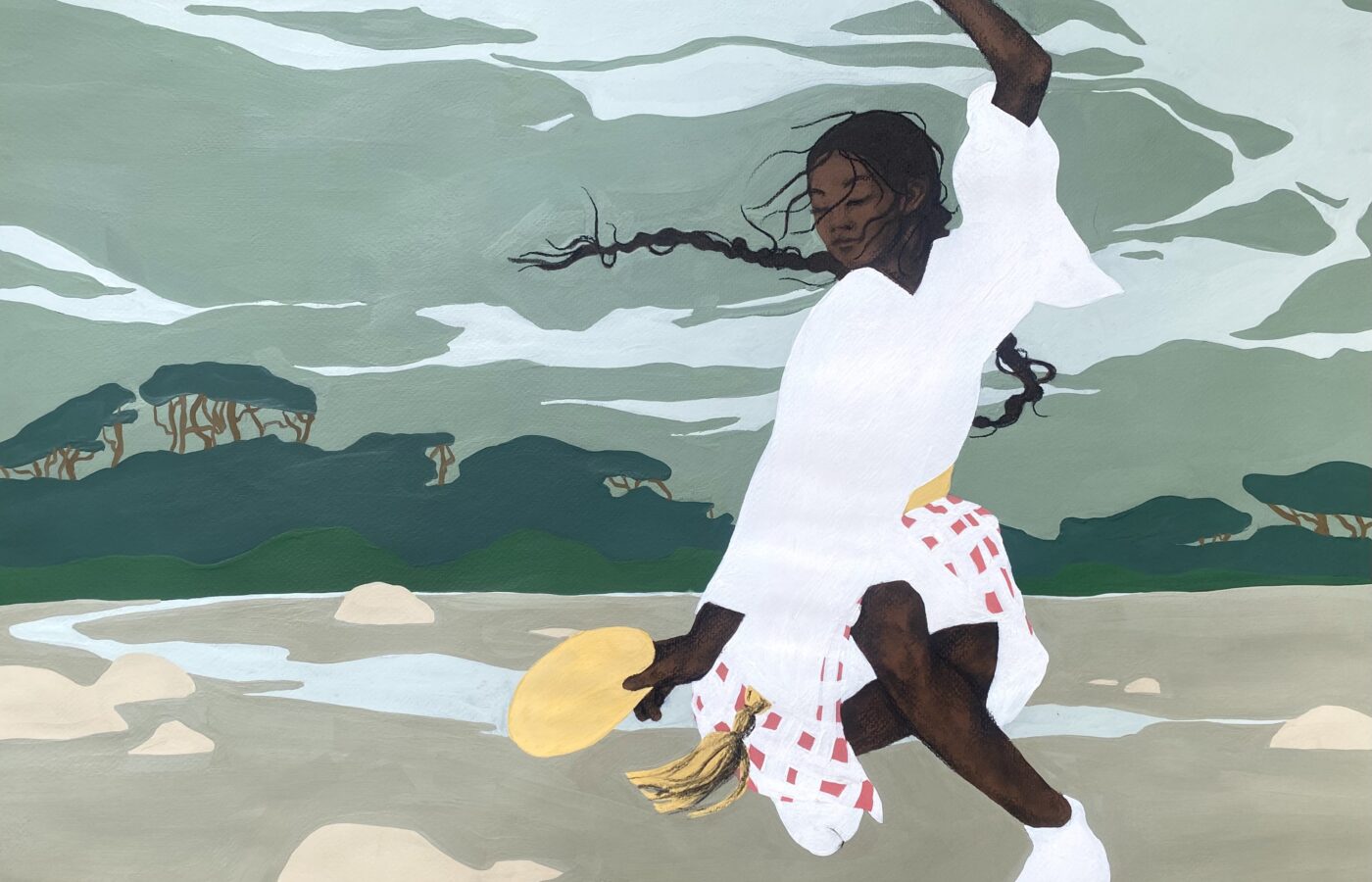
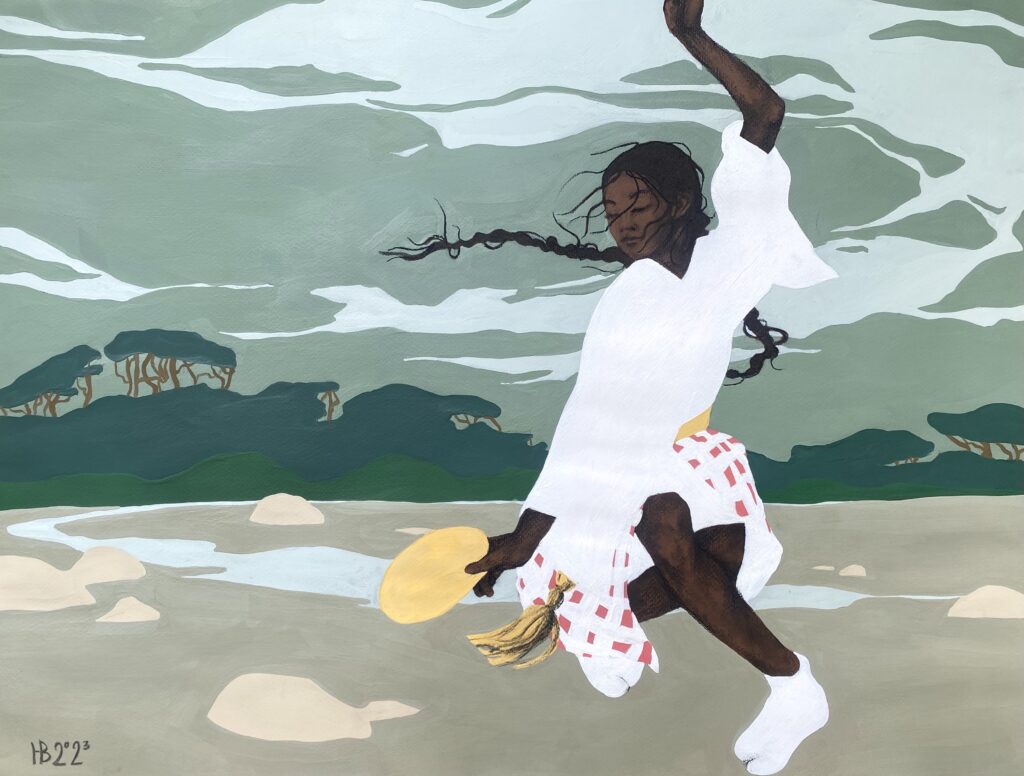
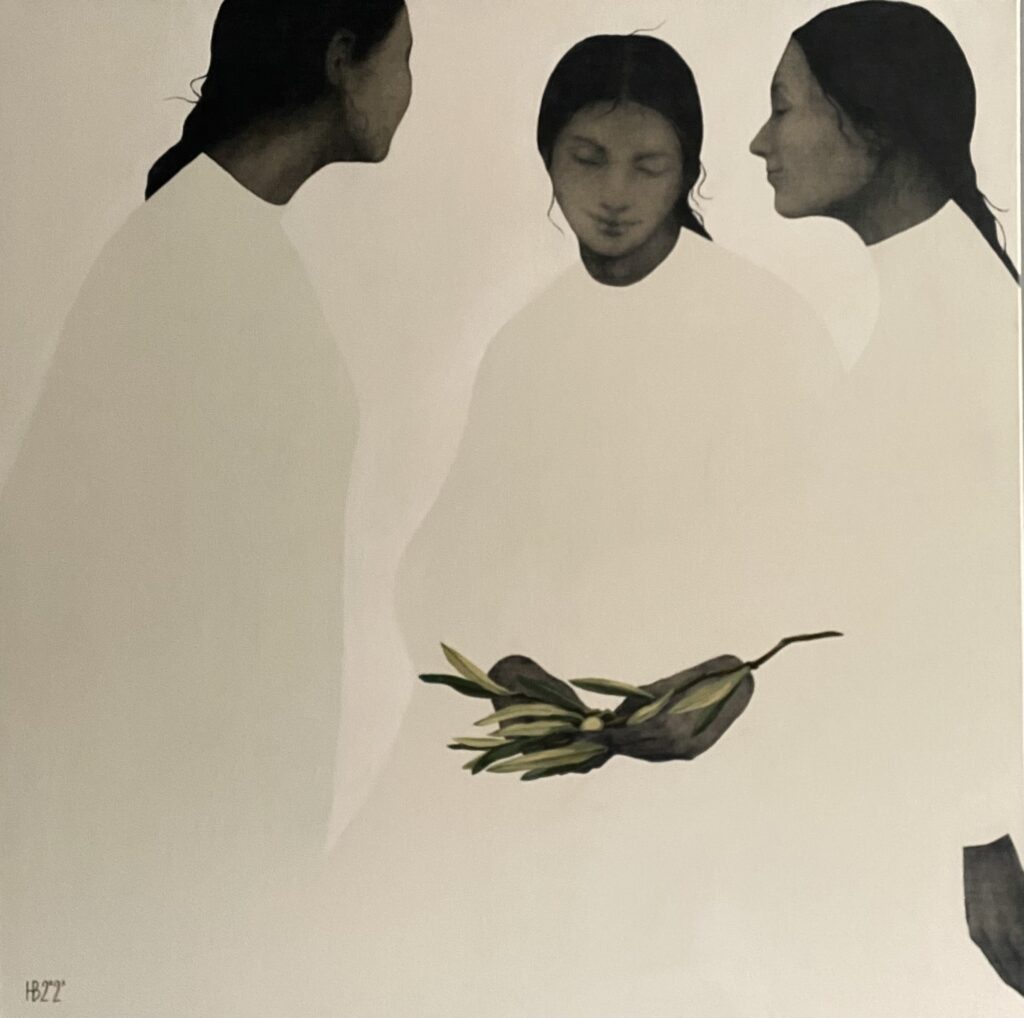
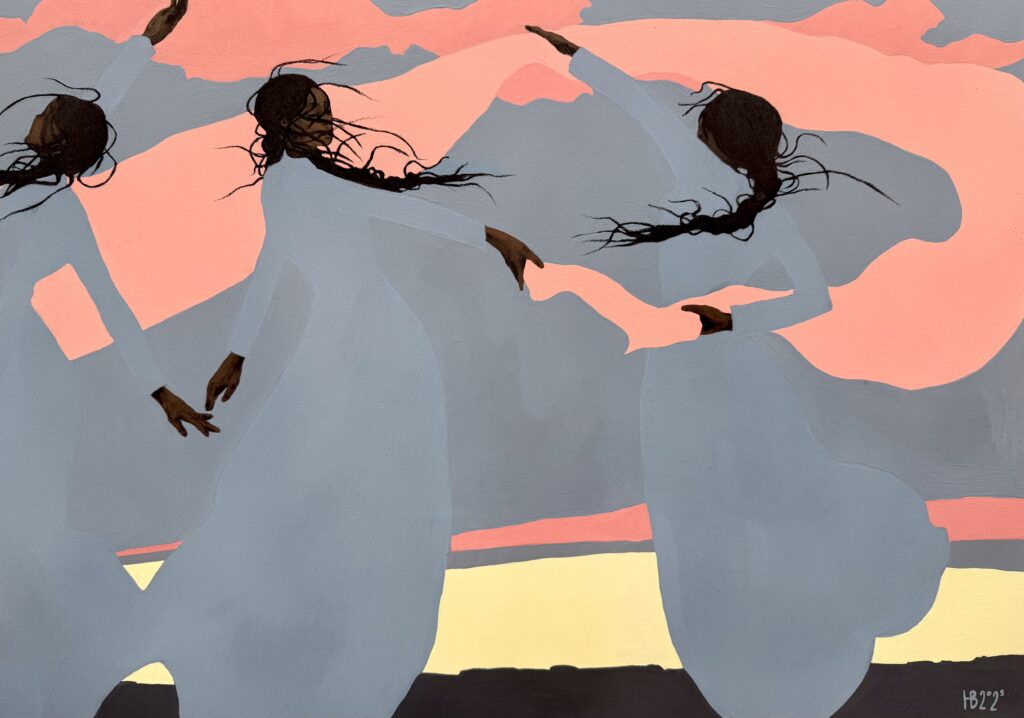
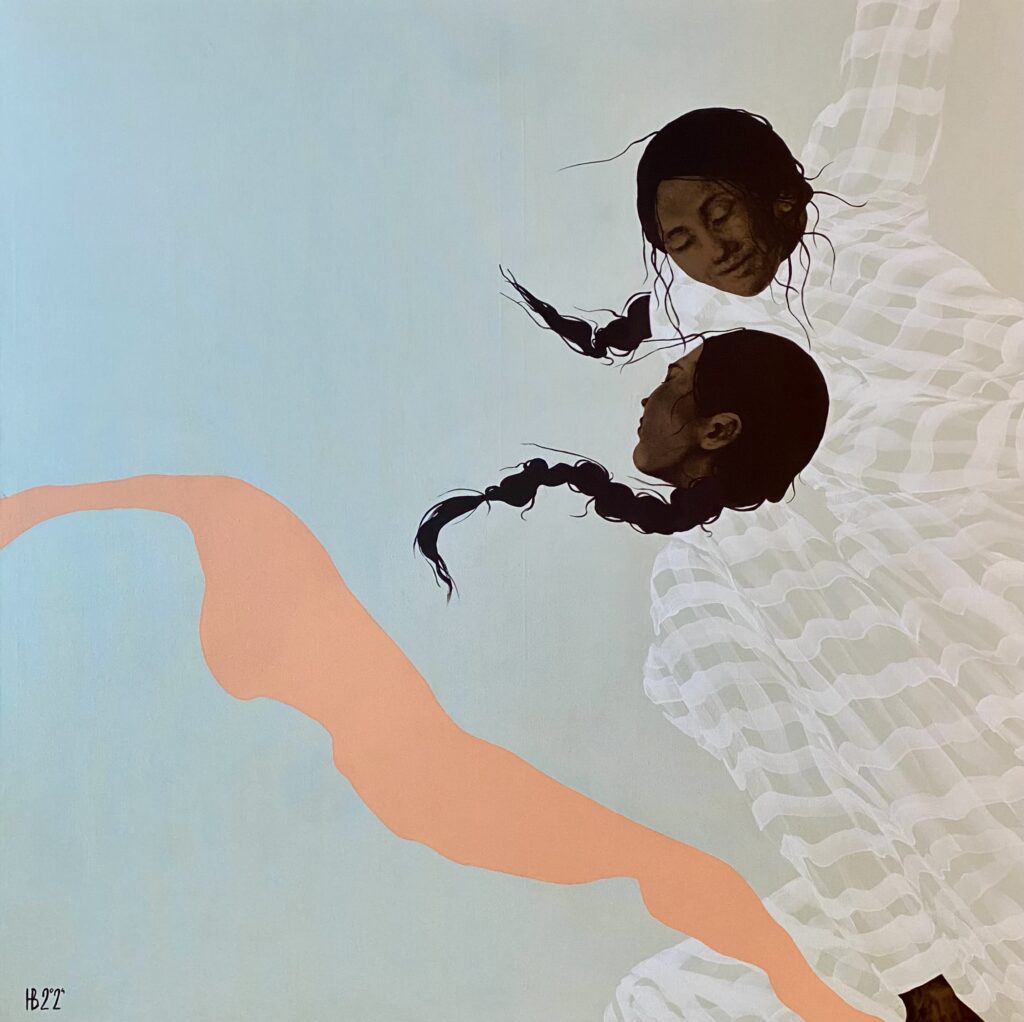
The spiritual resonance that is palpable across the canvas of her artistic endeavors ceremonializes centuries of shared intrinsic experiences into fathomable exteriors. Natalia’s world of colors builds upon plain silhouettes with dynamic faces and dramatic movements. Central figures of her composition are all women of distinct features, and her canvas is their stage. Their costumes, sometimes white, sometimes colored, and sometimes patterned or checkered, are in solidarity with the characters they are enacting for the audience.
They are meant to “evoke the viewer’s own memories” subtly. Her landscapes feature oceans, rivers, mountains, and valleys, and this spirit of nature permeates the essence of her figures as well. The modulation of a limited color palette adds a nostalgic dimension to her creations, where even vibrant hues can’t help but retain a somber tone. The overly simplified, almost generic background of her art pieces strikes an unusual equilibrium against the vivacious and expressive figures of her composition. Her muses are no wallflowers; they are unrestrained and daring, responding back to a profound inner calling often left unheard by many.
It was in a small town in the north of Western Siberia, where Natalia was born, a region dominated by the scarcely populated, mysterious, subarctic wilderness of Taiga. Both of her parents were engineers and worked for the Railways. And this is where she stayed up until the age of six, after which they moved to the Urals. Although her memories of this period are sparse, she could vividly recall the imposing and magnetic presence of northern Taiga: “I have a strong memory of the taiga—the real northern forest, vast, powerful, wild, mysterious, and slightly frightening, which was right there around us.” And this powerful version of Taiga always remained an intrinsic part of her inspiration and energetic signature.
After graduating from the Faculty of Fashion Design of the Ural State Academy of Architecture and Art, she created an independent clothing line showcasing her collections in seasonal fashion weeks. Around 2009 she shifted to Moscow and began working as a freelance costume designer for major Russian films and TV productions. But the unexpected intrusion of Covid-19 suddenly put a halt to everything and dramatically shifted her circumstances. During this deeply introspective time, she found a new alternative with an old practice.
Drawing has been a part of her life for as long as she can remember, a meditation for which she never needed any acknowledgement or appraisal. “I wasn’t particularly interested in showing my work or taking part in exhibitions either—I simply needed to draw.” However, April of that year proved to be momentous as she debuted in an online exhibition arranged in a private Facebook group, “The Ball and the Cross”: “For me, this was a chance to change my life, and I didn’t want to miss it.” And Success found her almost immediately afterwards. Her unique style featuring an exotic visage garnered intense applause and appreciation from people on the platform. With this recognition, she successfully transitioned to fine arts from costume designing.
While growing up, she was fascinated by Indian cinemas, once very popular in Russia. “I was fascinated by the Indian costumes, the physicality and movement, and the entirely different landscapes and colors. Everything about it was so unlike what surrounded me in my everyday life. And, of course, like many girls, I drew Indian princesses and different characters.” When reimmersing herself in this whole new artistic undertaking, she started on an “Ethnographic” series at the end of 2020. It consisted of a series of portraits of people of diverse ethnicities around the world. And it was at this time that she discovered her signature figures, who prevail in her creative landscape. A strong jaw with prominent cheekbones and slightly narrow slanting eyes is how she envisions her muses. They bear an irrefutable resemblance to Asian countenance: “As for Asian features in my faces… I’m often asked this question, and I don’t know the answer. Frankly, I never attached much importance to it. When I was working on portraits of people of various nationalities for the “Ethnography” series, I realized that Asian features really attract me.”
“I want you to return to your memories and recall those moments when you consciously connected with nature.”
Nostalgia dictates her world-building. From pristine snow valleys to scenic grassy clearings, from ashen peaks to churning seas, and from romantic streets of Venice to picturesque coastal towns of France, her muses carry a strange cathartic gravity. The white-worn, recurring dancing figures often observed in her projects are reminiscent of ethnic groups across the world. The unbridled joy in their swaying movements—twirling their long scarves in the wind and embracing life with open arms—is one of the most distinctive features of her evolving body of artworks: “The characters in my works are often in motion, while nature in the background is calm, monumental, and immovable, reminiscent of the extreme fragility of humans compared to the eternal force of nature.” Their loose-fitting, flared white garments, symbolizing sacred unity with the divine, virtually transform into regalia for the figures in her compositions. Her “Round Dances” series, is one such example. Apart from their clothing, another signature feature would be the hairstyles—single-, double-braided, or left open—each conveying significant spiritual and traditional imprints of myriad generations of men and women. These nomadic traditions are, however, not simply limited to the Slavic plains but disseminated across the world.
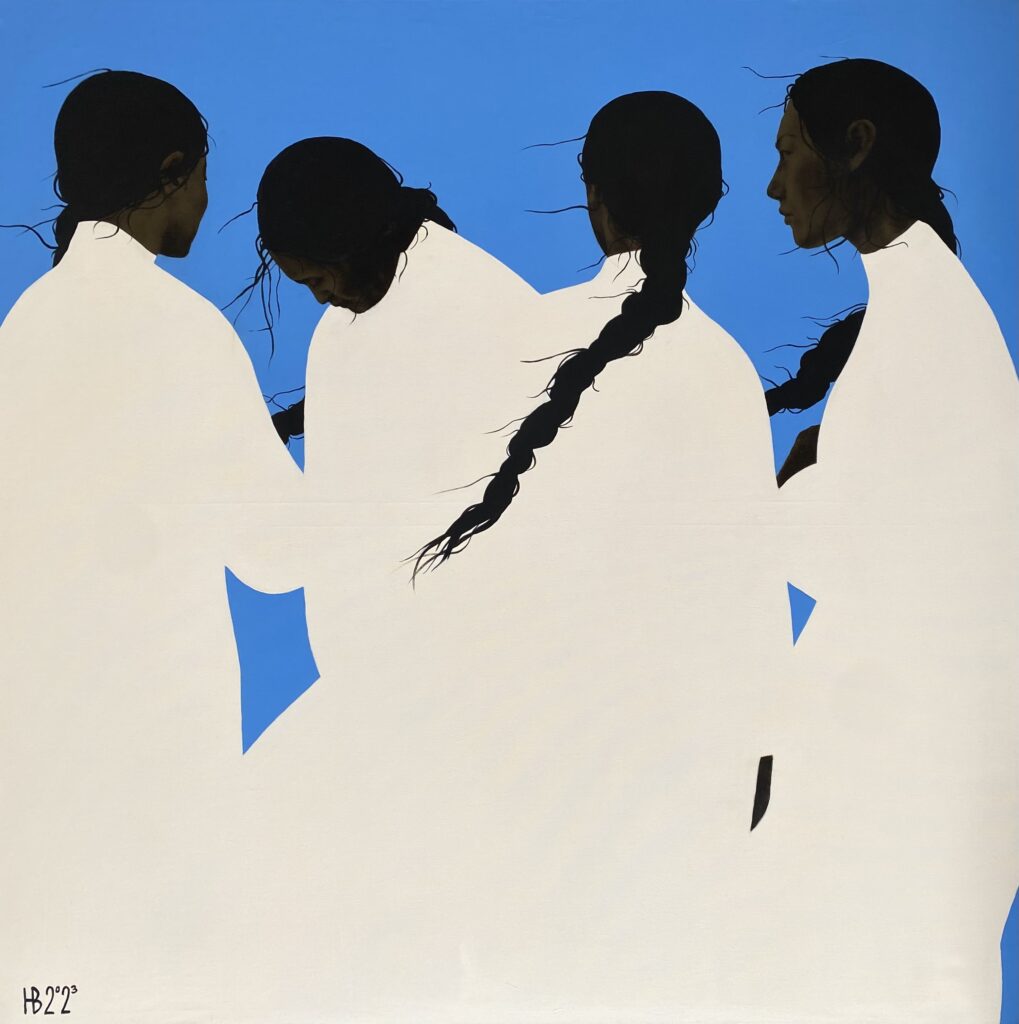
“The Artist’s Gift,” at Cuba, Moscow, organized by Maxim Boxer, the founder of the Facebook group “The Ball and the Cross,” was the first group exhibition that she participated in after her virtual pursuit. This endeavor propelled her towards the next stage, where she presented her first large-scale solo exhibition, “White Noise.” The featured ensemble of figurative artworks calls for an unusual insurgency against unnecessary clutter, presenting a point of absolute disassociation from every aspect of reality. It leaves nothing except the physical parts you were born with. Just as white light combines all colors of the visible spectrum, white noise assembled all audible frequencies at equal intensity, rendering everything outside of you ineffective. They are about giving you the respite to create your own world: “I will work. It will be all about my world, not the people or events around me. There are many things in my world; there is sadness, confusion, and regret, but it has more love, wind, freedom, silence, and peace. Your world is what you choose to hear and see.
My works feature a lot of water (rivers and seas), earth (mountains, fields, or steppes), and air (wind), precisely because that’s where I draw my strength.
Nature serves as a poignant emulator of her inner canvas. Be it the turbulent sea crashing against the seashore or the unruffled, tranquil sea face, both are expressive of inner turbulence or serenity. However, the most impactful rhythmic partner of her concurrence is the wind. The artwork “Healing through Dance” portrays a secluded moment of recovery, swaying with a flurry as a gust of wind ruffles her unbound hair. Her two other artworks, “The Willow the Wind” and “Stronger than Wind,” present a dichotomy. The former reflects the sensation of being swayed by external forces, whereas the latter displays the strength to resist and persevere. “Lark” captures a figure in a fleeting second of absolute release. Nothing tethers her to this reality; she is as free as her flowing hair and as free as the vast expanse of Steppe. Another artwork, “How long? Forever?”, echoes with a sense of desolation as it features two female figures in white attire staring at the endless stretch of snow-powder valley, awaiting something or someone.
The advent of her artistic career brought her to an adventurous avenue when she resolved to spend a year and a few months of her life in Japan, a place she had previously visited but only as a traveller. This was a period of rediscovery. Although an earlier introduction through “Wim Wenders’s Film Notes on Clothes and Cities” had already incited her fascination with Japan, what truly inspired her decision was her desire: “for a deeper immersion in the culture, the traditions, but most of all, of course, the people.” However, this progression was not without its challenges. Estranged from her social and familial roots in a foreign land left her depleted of the initial excitement she boarded the flight with. Alienation infiltrated her visual narrative as it dramatised social isolation. Two acclaimed artworks—”On Her Own” and “Empathy”—painted and exhibited during this time, elucidate the superficiality of connection and lack of meaningful interaction. Nonetheless, this fluctuation only served to intensify her resolution, as evident in her later artworks—”Fan Dance”, “Poppy Red Samurai’s Colours” and “You Me Her”, etc.
I search for a point of support and equilibrium, finding them in the fundamental elements of spiritual development—unity with nature, creation, and preservation of cultural codes.
Evanescence saturates the complexities of her figurative oeuvre as it emulates the ephemerality of human presence and experience. This epiphany is not restrained to her graphical concept but is also reiterated through her choice of medium: “I emphasise the fragility and temporality of humans by using charcoal to create faces and visible body parts, a delicate, impermanent material.” While circumstantial stipulations influence the colors appearing in her creative backdrops and wares: “In landscapes and objects, especially in clothing, color emerges.”
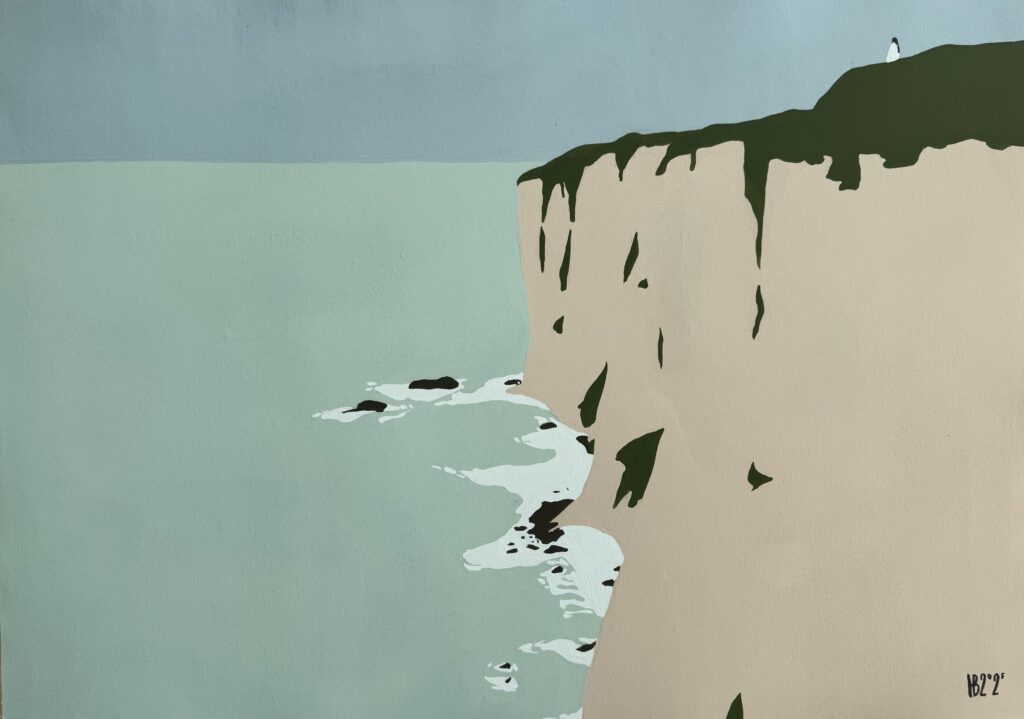
Although her sojourn in Japan has ended, her journey has just begun. Zanchevskaia has found her new home in France with occasional intervals of roving around the world whilst still processing the accumulated experiences. She explicates the venues of her exploration—”The Etretat,” “The Gardens of Livia”—in an abstracted realism where the natural topography is reduced to a tessellation of geometric planes. While earthly grey, stark white, deep browns, and aquatic turquoise evoke calm and serenity. Her muses now embody the spatial spirit.
Her subjects gradually transform into receptacles of memories, tracing the snippets of their elusive existence through remnants of their lost possessions. “A person, living their short life, eventually disappears completely, leaving a trace of their existence in objects.” Zanshin 残心, or remaining presence, is one such artwork that reenacts forgotten timelines and individuals through their traces. It portrays the memory of a Japanese female in a beautiful, blue kimono that Natalia created while musing upon a small fragment of fabric that she found at an antique market in Takayama—the remains of a hundred-year-old kimono.
I don’t know who wore it or what she thought about it.
What remains are the patterns and the history they represent.
About The Author
