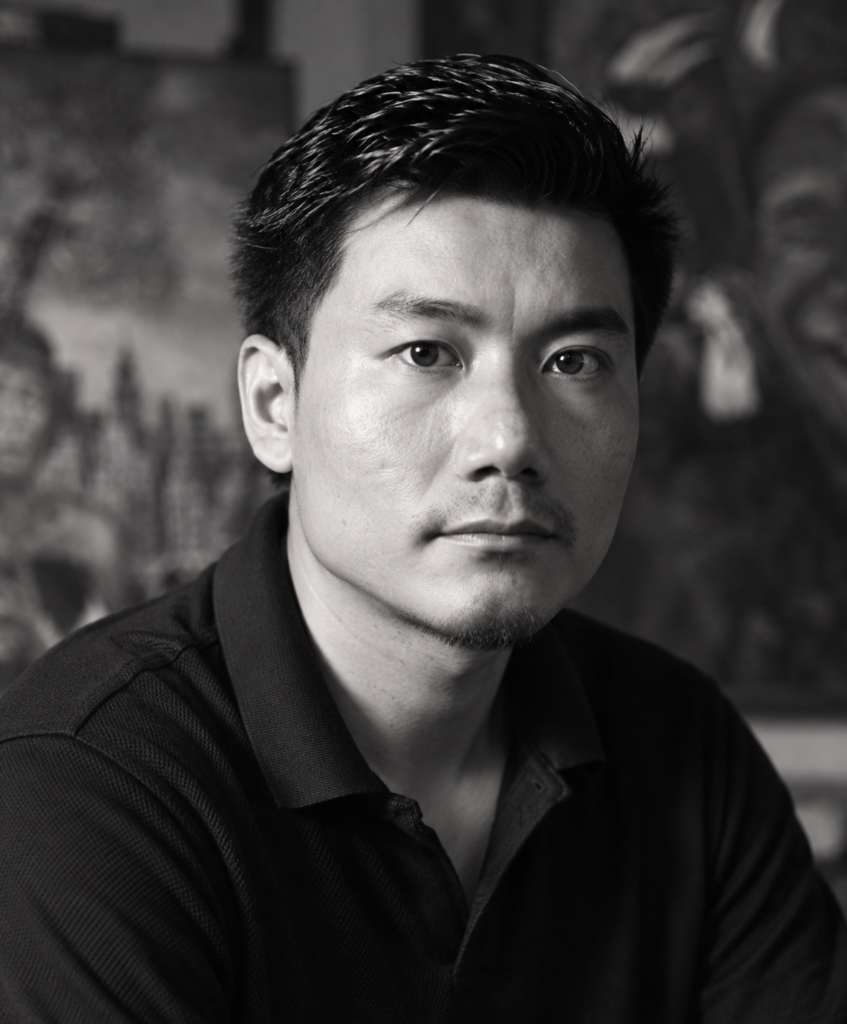
An exclusive interview with Lipok Manen

“I’m mostly inspired by my rich Naga culture. To me, it’s the very fabric of our identity as well as our beautiful existence. I believe that silence speaks louder than words, but a picture speaks a thousand words.” — Lipok Manen
Realism in Manen’s Creative Sanctuary is the mystical summoning to the tropical woodland of Nagalim. The moss-laden, dew-drenched, epiphytic arbor of his homeland and its people harbors the thematic indulgence of his scenic artscapes. The organic portraiture of Naganchi is its authentic glory: from undistorted illustrations of gnarly, ancient trees erected over green-carpeted rocky terrain to aeroscapic biomes of varigated orchids, from yellow casquetted Indian hornbills to the suosuok-worn tribal herald of Konyak—all seemingly innocuous, picturesque features of this ancient land characterized by internal luminescence and dramatic chiaroscuro appear repetitively in his conceptual paysage. His sylvan landscapes are not merely ornamental; they are an apomorphic study of commensalism—where different organisms can sustain themselves without taking from the other—as a symbiotic interplay of dominant and analogous color palettes insinuated with vibrant accents breathes life into his vision.
His graphic rendition of folk figures is reminiscent of George Catlin’s ethnographic series on American indigenous tribes, as layering and stippling with tight, repetitive brushstrokes accentuate the realistic vibrancy of his creative endeavor. To simplify, Manen’s naturalistic concoction is a cathartic expedition to the autochthonous foundation of the land of Nagas.
An evergreen rainforest of diversified flora and fauna immersed in perpetual twilight hegemonizes the compositional elements of his ecological landscapes. The series on “Wild Orchids” exemplifies his passionate delineation of the rich, enigmatic aeroplant-infused treescapes of Nagaland. It captures a thick, diagonal, scaly branch of a tree against a dark or vibrant orangish-red hue background, embellished in a velvety cushion of plaited moss and lichens, displaying an assortment of colorful aerophytes—light pink and lavender orchids along with a cluster of elongated, bright green bromeliads—while a flutter of monarch butterflies and blue butterflies hover over the flowers. The dramatic contrast between the dark silhouette and the accented part adds a mystical illusion to these botanical illustrations. Manen’s archaic woodscape further features lines of aged, twisted trees speckled in a crusty, flat coat of crustose lichens, while its rocky forest floor, blanketed by layers of moss, gleams in the vibrant shade of green illuminated by the dappled sunlight filtering through the overgrown canopy. The diffused, ambient lighting served to amplify the overall fantastical effect of the art piece.
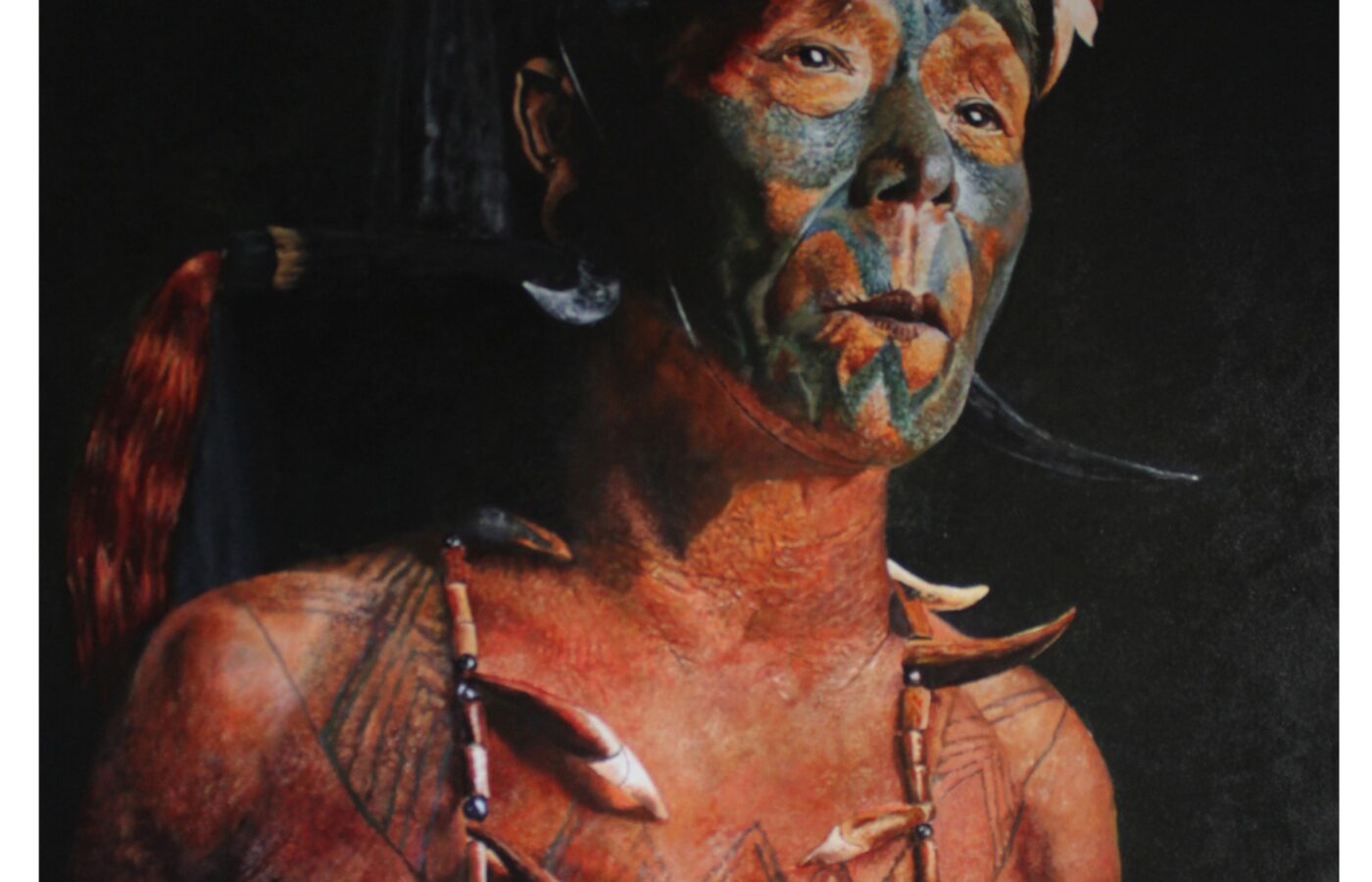
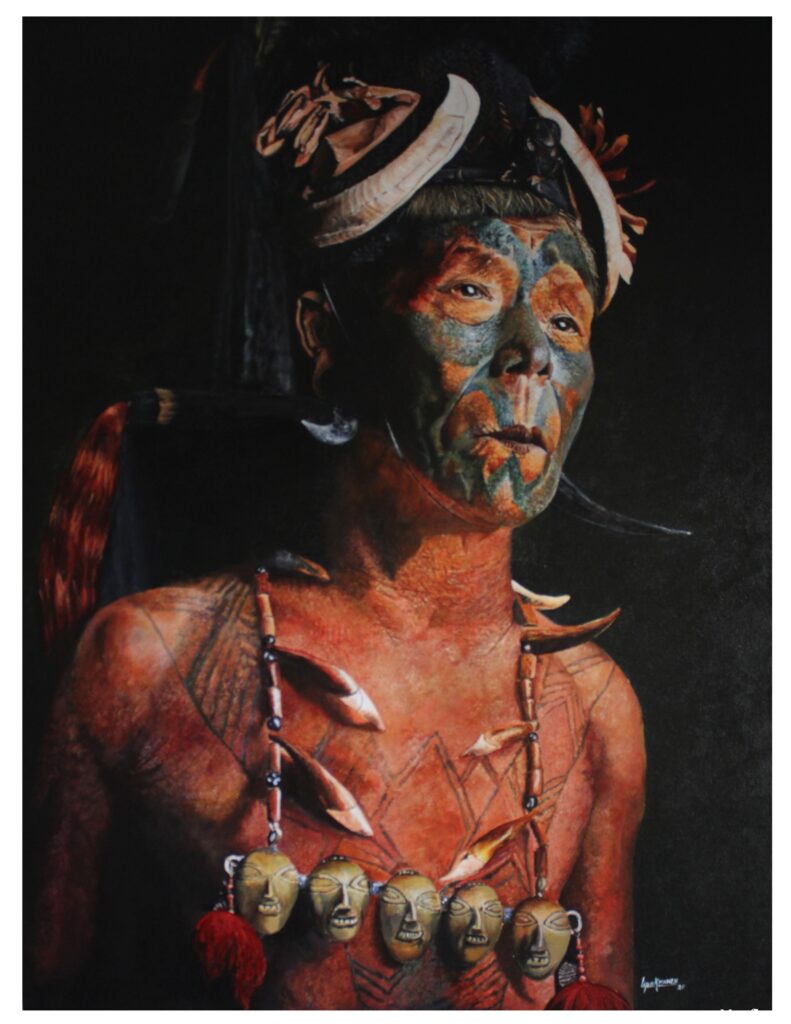
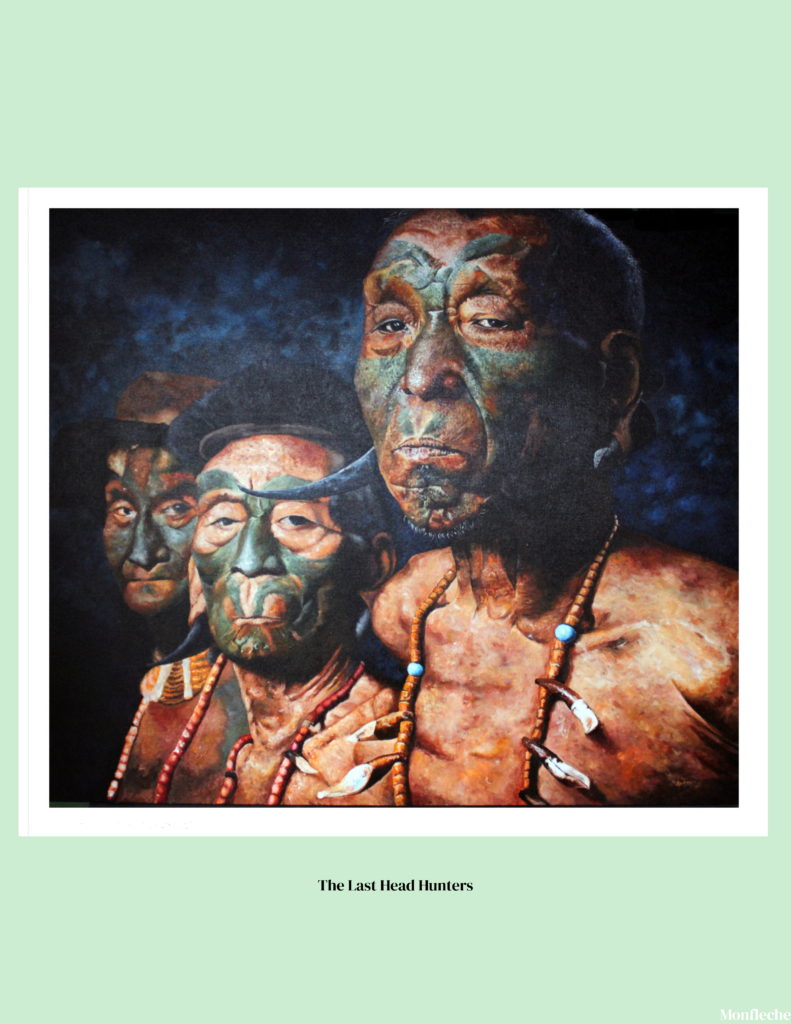
The majestic, yellow-casquetted hornbill, a celebrated avian of this humid woodland, with its massive yellow beak and stocky, robust body striped in dark and white patch marks, appears multiple times in his creative projects. However, his figurative artscape is mostly dominated by the people of his native land. His series of “Last Head Hunters,” dedicated to the warriors of the “Konyak Naga Tribe,” conceives portraits of tribal men in their aboriginal attire and appearance. Greenish-blue-black paint frames their noses, cheekbones, and foreheads in bold geometric shapes, while large boar tusks wrapped with shiny thread are inserted through their stretched ear lobes. Finally, a conical hat ornamented with boar tusks and bristles crowned their head. These ornamental elements are not merely superficial costumes; they are symbolic honors attributed to warrior chiefs, who have passed the threshold of adolescence and have hunted the head of an enemy, proving their might and strength.
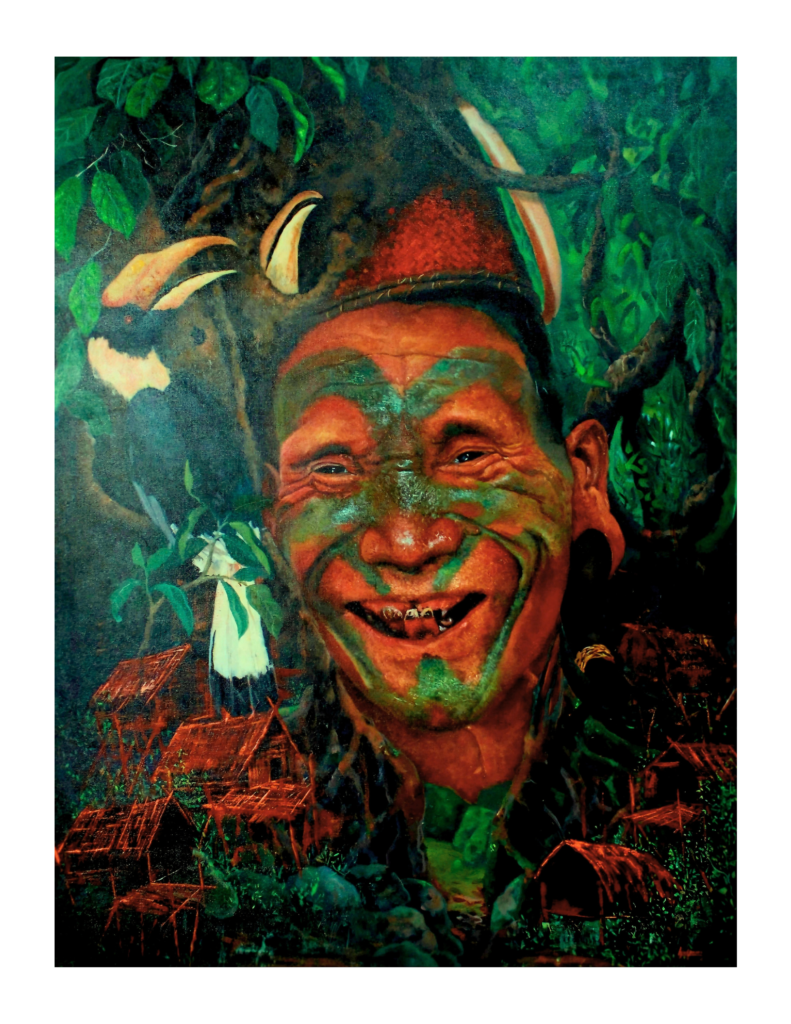
In Manen’s later artworks, these indigenous figures eventually surpass the limitation of their tribal identity and integrate with nature. The series named “Nature connectedness” envisages the ethnic figures as almost blending in with the surrounding landscapes, as if the tropical forest, birds, and the entire ecosystem are an extension of their higher consciousness. Manen’s art serves as a desperate attempt to warn the world of the dire consequences of suffocating the natural ecosystem and the ethnic way of life. They paint a glaringly obvious picture of the Naga community and their natural heritage on the verge of a catatonic collapse as their lush woodlands, once thriving with vivacious wildlife and miscellanous vegetation, confront extinction due to illegal lumbering and hunting rampages while rapid urbanization and modernization threaten their cultural heritage and unrestrained, tribal practices.
Could you tell us about your childhood? What are your earliest memories of art? Was there a particular moment when you realized that becoming an artist was your calling? Did your family encourage your artistic pursuits, or was it something you had to discover on your own?
I was born and brought up in a small village, Changtongya village. I had a simple childhood, and I grew up surrounded by nature and the culture of my community. From an early age, I was interested in drawing and creating things with my hands. I think those early experiences slowly developed my interest in art. There was no particular moment when I decided to become an artist. It happened gradually. As I continued drawing and creating artwork, I realized that art was something that made me happy and allowed me to express my thoughts and feelings. Over time, I understood that being an artist was not just a hobby for me—it was something I wanted to continue seriously. My family encouraged me, although I also had to discover my own path as an artist. Like many families in Nagaland, there was an expectation to choose a career that was considered more secure and practical. Where art was often seen as a hobby rather than something that could become a full-time profession. Their support gave me confidence to continue, while my own experiences and interest in art helped me understand what I wanted to do. As I grew older, I became more interested in expressing my connection with nature, my surroundings, and my cultural background through my artwork.
Your educational background and artistic development (· How did your artistic education shape your perspective as a painter? · Were there any teachers, mentors, or fellow artists who significantly influenced your development? · Looking back at your earliest works, what do you think has changed the most in your artistic language?
I don’t have any formal education or training in art. I am a B.Com graduate. My journey as an artist has mostly been through self-learning, practice, observation, and experience. Since I did not study art, my education did not directly shape me as a painter. Instead, I learned by observing other artists, studying different styles, experimenting with different techniques, and continuously practising. I did not have a formal art teacher or mentor. However, other artists and their works have influenced me. Talking to fellow artists, seeing their work, and learning from their experiences has helped me improve. I think the biggest change is in my confidence and understanding of what I want to express. My early works were more about learning and trying different things. Now, I have a clearer idea of what I want to say through my paintings.
Do tell us about your artistic style & process of art-making. Describe your artistic style in your own words. · Where do your ideas usually originate—from observation, imagination, memories, emotions, or something else? creative process, from the first spark of an idea to the finished painting? · How much planning goes into a work before you begin, and how much is discovered during the painting process?
My artistic style is simple and mostly inspired by nature, people, my surroundings and my childhood memories. My ideas usually come from what I see around me, my memories, experiences, and sometimes my imagination. I normally start with a basic idea or sketch, but I do not plan everything in detail. As I paint along, I allow the work to develop naturally. Sometimes the final painting becomes different from what I first imagined, and I enjoy that part of the process.
Impact of History and Society on Your Artworks
History and society have a strong influence on my artworks. Growing up in Nagaland, I am inspired by our culture, traditions, nature, and the changes happening around us. I try to show these experiences through my paintings. I hope my artworks help people understand and connect with our land, people, and way of life.
What themes consistently appear in your work, and why do they resonate with you?
The main themes in my work are nature, people, culture, and everyday life. I am inspired by the hills, forests, rivers, and villages of Nagaland. I also draw inspiration from Naga traditions, traditional houses, village life, shawls, and local festivals. These themes are close to me because they are part of my surroundings, memories, and experiences.
Visual elements that hold personal significance
The visual elements that are important to me are mountains, forests, trees, rivers, and Naga village life. I also find traditional Naga patterns, shawls, houses, and everyday objects meaningful. These elements remind me of my roots, memories, and connection with my people. Through my work, I hope to preserve and share our rich traditions for future generations.
Technique & Materials
I mainly work with acrylic colours on canvas. I use brushes and sometimes palette knives, with layering and glazing techniques. I prefer natural and earthy colours such as green, brown, blue, and yellow. I use these colours to express nature, emotions, and my surroundings.
Impact of challenges on your creativity
One of the main challenges I face is finding enough time and support to continue my art. But these challenges have encouraged me to work harder and express my thoughts through painting.
One of my artworks, based on the theme “Nature Connectedness”, was inspired by a hiking trip. During the trip, I realized how closely humans and nature are connected and how we should live together in harmony. This experience inspired me to create the artwork.
About The Author
